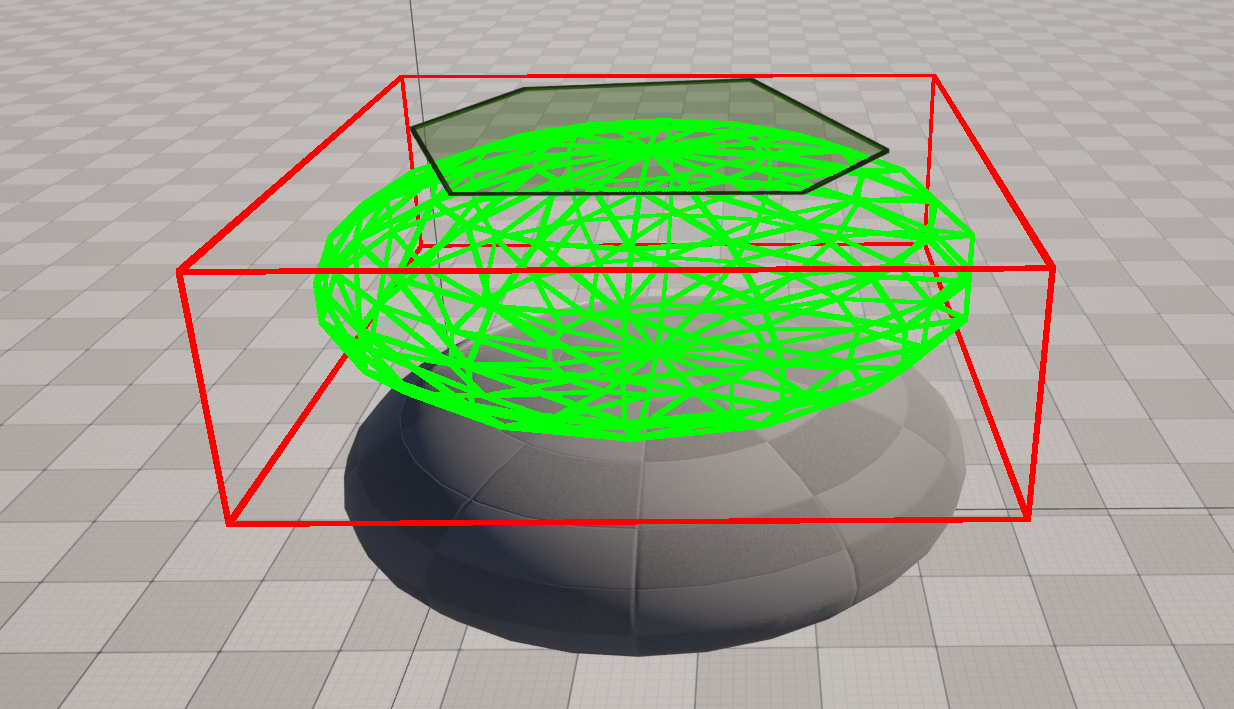
See also Navigation Data.
Note on
IsNavigationRelevantThe virtual function
UActorComponent::IsNavigationRelevantwhich is mostly known for its implementation inUPrimitiveComponentwill by default return true if the primitive has the channelsPawnandVehicleas blocked.
Registration process
When a primitive component is registered and bCanEverAffectNavigation is true as well as IsNavigationRelevant, FNavigationSystem::OnComponentRegistered is called.
This will call UNavigationSystemV1::RegisterComponentToNavOctree, which checks that the component implements INavRelevantInterface and checks AActor::IsComponentRelevantForNavigation.
If the nav generation type is not static, the following happens:
UNavigationSystemV1::RegisterNavRelevantObjectStatic is called which calls UNavigationObjectRepository::RegisterNavRelevantObject.
This internal creates a new FNavigationElement instance (see UNavigationObjectRepository::RegisterNavRelevantObjectInternal and FNavigationElement::InitializeFromInterface).
FNavigationSystem::OnComponentUnregistered is called when the component unregistered (as well as some similar path that the register one).
Refreshing the nav data
In editor when you update a component collisions UActorComponent::DestroyPhysicsState will be eventually called. This will trigger a callback to UNavigationSystemV1::UpdateComponentInNavOctree which calls UNavigationObjectRepository::UpdateNavigationElementForUObject, this will find an existing FNavigationElement in UNavigationObjectRepository::RegisterNavRelevantObjectInterna and override it with a new “instance”.
Geometry Export
The recast nav system gathers the geometry (called “Exporting” in the engine) to know if its relevant to generate walkable surfaces.
For example in FNavigationOctree::AddNode, if bGatherGeometry is true it executes the GeometryExportDelegate delegate if its synchronous (see FNavigationOctree::IsLazyGathering). The delegate is set in UNavigationSystemV1::ConditionalPopulateNavOctree and point to the static function FRecastGeometryExport::ExportElementGeometry.
Inside RecastGeometryExport::ExportObject is called, as well as RecastGeometryExport::ConvertCoordDataToRecast and RecastGeometryExport::StoreCollisionCache.
Inside ExportObject, GeometryExportType is checked, if not set to No then the CustomGeometryExportDelegate delegate of the processed FNavigationElement is called. This will call INavRelevantInterface::DoCustomNavigableGeometryExport.
For a UStaticMeshComponent this runs FStaticMeshComponentHelper::DoCustomNavigableGeometryExport. If the scale is zero it is skipped.
Then UNavCollision::ExportGeometry will be called.
This will call ExportCustomMesh on the passed FNavigableGeometryExport (in this case a FRecastGeometryExport) we are filling. The function internally calls RecastGeometryExport::ExportCustomMesh, which uses the input vertex and index data with the internal VertexBufffer and IndexBuffer it holds (see FRecastGeometryExport members).
At the end if no custom export data was found and if the nav element has a BodySetup RecastGeometryExport::ExportRigidBodySetup is called.
Snippets
Debug Exported Nav Geo
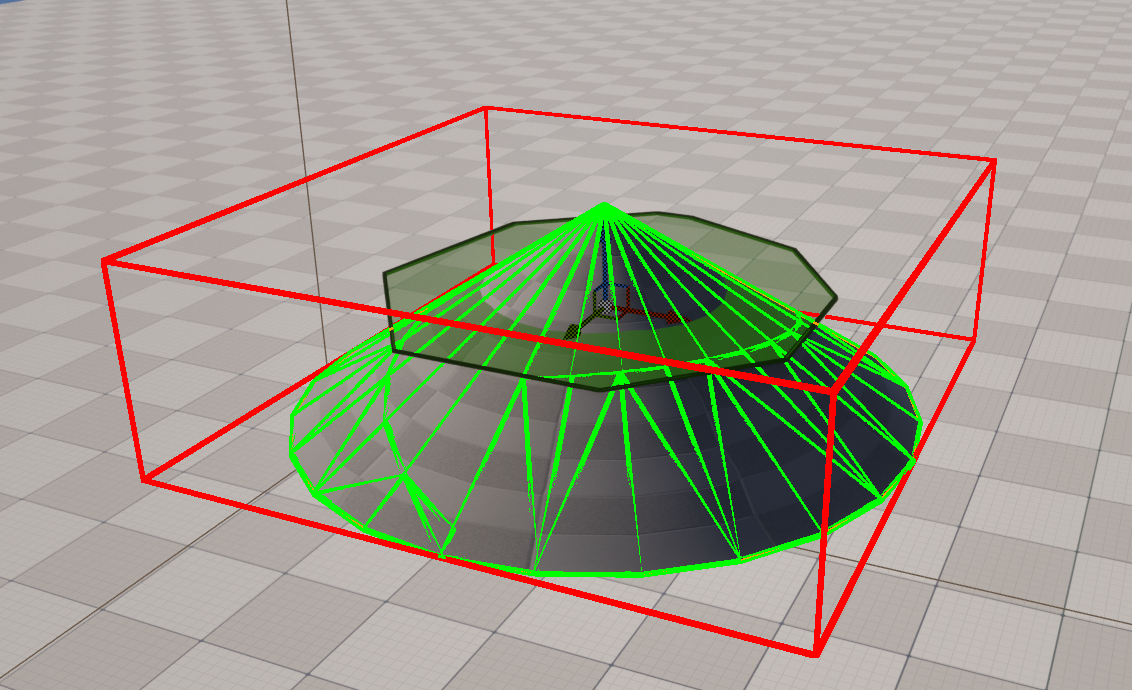
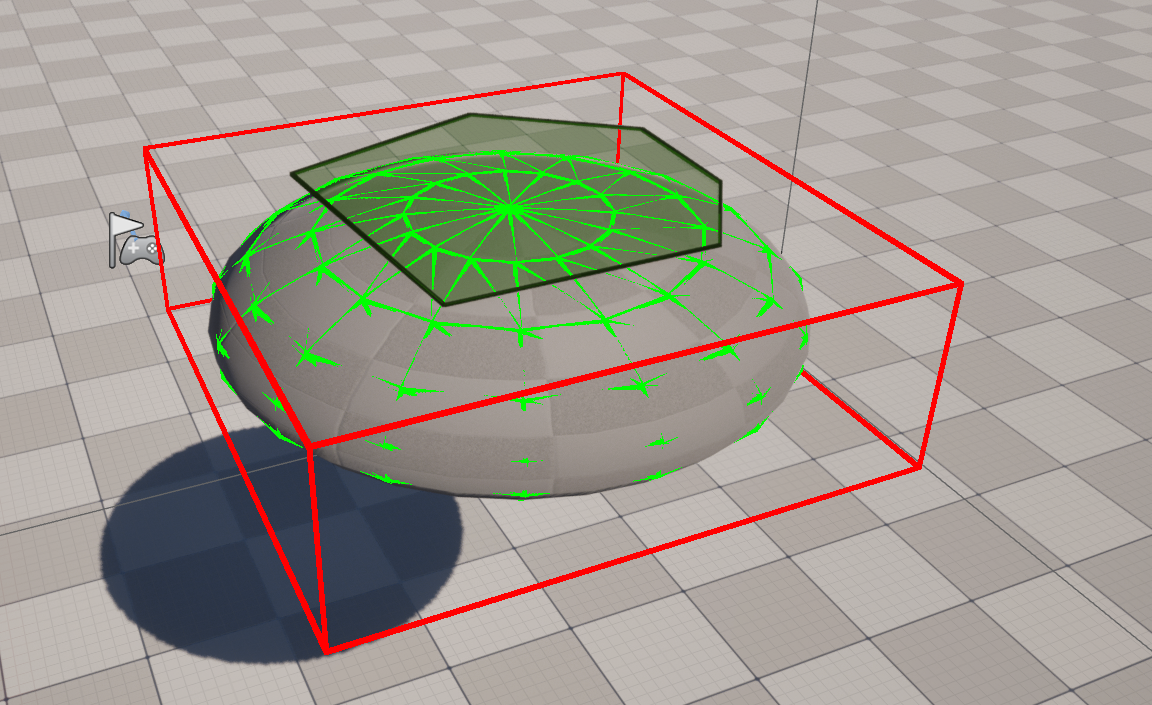
Here is a code snippet you can use to debug the exported nav geometry:
// Note: FU::Draw functions comes from my FishyUtils plugin.

bool USANTestStaticMeshComponent::DoCustomNavigableGeometryExport(FNavigableGeometryExport& GeomExport) const
{
	const bool bResult = Super::DoCustomNavigableGeometryExport(GeomExport);

	auto& RecastGeoExport = static_cast<FRecastGeometryExport&>(GeomExport);

	if (RecastGeoExport.Data)
	{
		// debug bounds
		FU::Draw::DrawDebugBox(
			GetWorld(),
			RecastGeoExport.Data->Bounds.GetCenter(),
			RecastGeoExport.Data->Bounds.GetExtent(),
			FQuat::Identity,
			FColor::Red,
			10
		);
	}

	// reconstruct exported mesh from vertex bufffer
	const int32 TriangleCount = RecastGeoExport.IndexBuffer.Num() / 3;
	for (int32 TriangleIndex = 0; TriangleIndex < TriangleCount; ++TriangleIndex)
	{
		const int32 IndexOffset = TriangleIndex * 3;

		const int32 Index1 = RecastGeoExport.IndexBuffer[IndexOffset];
		const int32 Index2 = RecastGeoExport.IndexBuffer[IndexOffset + 1];
		const int32 Index3 = RecastGeoExport.IndexBuffer[IndexOffset + 2];

		const FVector Pos1 = FVector(
			RecastGeoExport.VertexBuffer[Index1 * 3],
			RecastGeoExport.VertexBuffer[Index1 * 3 + 1],
			RecastGeoExport.VertexBuffer[Index1 * 3 + 2]
		);
		const FVector Pos2 = FVector(
			RecastGeoExport.VertexBuffer[Index2 * 3],
			RecastGeoExport.VertexBuffer[Index2 * 3 + 1],
			RecastGeoExport.VertexBuffer[Index2 * 3 + 2]
		);
		const FVector Pos3 = FVector(
			RecastGeoExport.VertexBuffer[Index3 * 3],
			RecastGeoExport.VertexBuffer[Index3 * 3 + 1],
			RecastGeoExport.VertexBuffer[Index3 * 3 + 2]
		);

		FU::Draw::DrawDebugLine(
			GetWorld(),
			Pos1,
			Pos2,
			FColor::Green,
			10
		);

		FU::Draw::DrawDebugLine(
			GetWorld(),
			Pos2,
			Pos3,
			FColor::Green,
			10
		);
		FU::Draw::DrawDebugLine(
			GetWorld(),
			Pos3,
			Pos1,
			FColor::Green,
			10
		);
	}

	return bResult;
}
Example results:
Edit Exported Nav Geo
bool USANTestStaticMeshComponent::DoCustomNavigableGeometryExport(FNavigableGeometryExport& GeomExport) const
{
	const bool bResult = Super::DoCustomNavigableGeometryExport(GeomExport);

	auto& RecastGeoExport = static_cast<FRecastGeometryExport&>(GeomExport);

	if (RecastGeoExport.Data)
	{
		RecastGeoExport.Data->Bounds = RecastGeoExport.Data->Bounds.ShiftBy(FVector(0, 0, 100));
	}

	const int32 TriangleCount = RecastGeoExport.IndexBuffer.Num() / 3;

	// we have to track edited Z values since the VertexBuffer contains unique vertex coords
	TSet<int32> EditedZIndices;
	EditedZIndices.Reserve(RecastGeoExport.IndexBuffer.Num());

	auto KeepOrEditZVal = [&EditedZIndices] (int32 ZIndex, double& ZVal)
	{
		if (!EditedZIndices.Contains(ZIndex))
		{
			EditedZIndices.Add(ZIndex);
			ZVal += 100;
		}
	};

	for (int32 TriangleIndex = 0; TriangleIndex < TriangleCount; ++TriangleIndex)
	{
		const int32 IndexOffset = TriangleIndex * 3;

		const int32 Index1 = RecastGeoExport.IndexBuffer[IndexOffset];
		const int32 Index2 = RecastGeoExport.IndexBuffer[IndexOffset + 1];
		const int32 Index3 = RecastGeoExport.IndexBuffer[IndexOffset + 2];

		double& Vertex1X = RecastGeoExport.VertexBuffer[Index1 * 3];
		double& Vertex1Y = RecastGeoExport.VertexBuffer[Index1 * 3 + 1];
		const int32 Vertex1ZIndx = Index1 * 3 + 2;
		double& Vertex1Z = RecastGeoExport.VertexBuffer[Vertex1ZIndx];
		KeepOrEditZVal(Vertex1ZIndx, Vertex1Z);

		double& Vertex2X = RecastGeoExport.VertexBuffer[Index2 * 3];
		double& Vertex2Y = RecastGeoExport.VertexBuffer[Index2 * 3 + 1];
		const int32 Vertex2ZIndx = Index2 * 3 + 2;
		double& Vertex2Z = RecastGeoExport.VertexBuffer[Vertex2ZIndx];
		KeepOrEditZVal(Vertex2ZIndx, Vertex2Z);

		double& Vertex3X = RecastGeoExport.VertexBuffer[Index3 * 3];
		double& Vertex3Y = RecastGeoExport.VertexBuffer[Index3 * 3 + 1];
		const int32 Vertex3ZIndx = Index3 * 3 + 2;
		double& Vertex3Z = RecastGeoExport.VertexBuffer[Vertex3ZIndx];
		KeepOrEditZVal(Vertex3ZIndx, Vertex3Z);

		const FVector Vertex1 = FVector(Vertex1X, Vertex1Y, Vertex1Z);
		const FVector Vertex2 = FVector(Vertex2X, Vertex2Y, Vertex2Z);
		const FVector Vertex3 = FVector(Vertex3X, Vertex3Y, Vertex3Z);
	}

	return bResult;
}
Example result: